
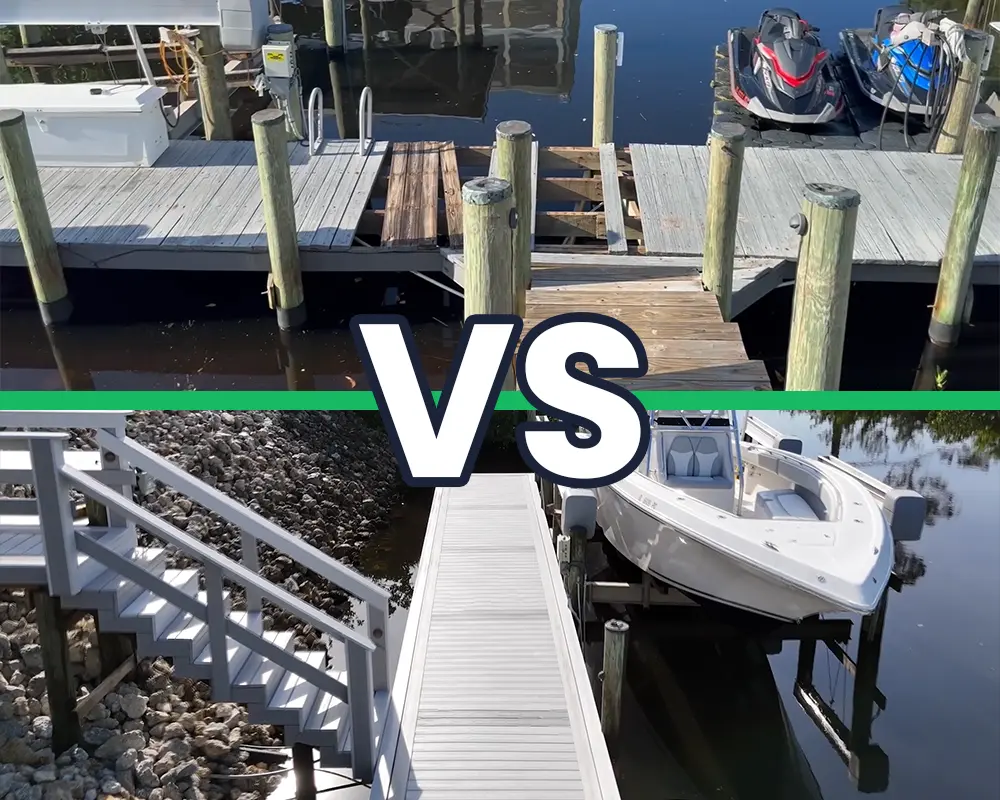
When you’re building or replacing a dock in Southwest Florida, choosing the decking material based on price alone can be an expensive mistake.
A dock in Naples, Marco Island, Bonita Springs, Fort Myers, Cape Coral, or anywhere along the Southwest Florida coast lives in an extremely demanding environment. Saltwater, intense UV exposure, humidity, heavy rain, tropical storms, and constant wet-and-dry cycles all take their toll.
Materials that perform perfectly well on a backyard deck may not be appropriate for a marine environment.
That’s why the question isn’t simply, “How much does this decking cost?”
The better question is, “How much will this decking cost me over the life of my dock?”
A less expensive material that requires regular maintenance and replacement can eventually cost more than a premium material designed to withstand the marine environment for decades.
TL;DR: What’s the Best Material for a Dock in Southwest Florida?
Pressure-treated marine lumber generally provides the lowest upfront cost, but it also requires the most maintenance and typically has the shortest lifespan. PVC, traditional composite decking, tropical hardwoods, aluminum, and reinforced polymer decking cost more initially but can provide substantially longer service lives with less maintenance.
For homeowners who plan to keep and use their dock long-term, Overall Outdoor & Marine Services recommends WearDeck™. Its wood-free, fiberglass-reinforced construction is specifically suited to demanding applications, including ground contact and underwater installations. It is also splinter-free, slip-resistant, heat-reflective, and backed by a limited lifetime residential warranty.
Why Marine Environments Require the Right Materials
Your dock isn’t just another outdoor deck.
A residential deck might have to contend with rain and sunlight. A Southwest Florida dock adds saltwater, salt spray, constant humidity, marine organisms, occasional submersion, and some of the strongest UV exposure in the country.
Those conditions accelerate deterioration.
Wood can absorb moisture, split, warp, splinter, and eventually rot. Metal hardware that isn’t designed for marine use can corrode. Some synthetic decking products aren’t designed for continuous contact with water or underwater installation.
The decking is also only one part of the equation. Pilings, framing, joists, fasteners, and hardware all need to be appropriate for their particular exposure. In saltwater environments, proper marine-grade framing and corrosion-resistant hardware are critical to the lifespan of the entire dock.
Using the wrong material might save money during construction, but those savings disappear quickly if you’re repairing or rebuilding sections of the dock years earlier than expected.
Watch What Goes Into a Dock Rebuild
We’ve seen firsthand what happens when docks age in Southwest Florida’s marine environment.
In this Overall Outdoor & Marine Services dock rebuild, you can see the process of taking an existing waterfront structure and giving it a new life:
Watch the Overall Outdoor & Marine Services Dock Rebuild
Projects like this are a good reminder that when you’re already investing in rebuilding a dock, the materials you choose determine how soon you’ll have to think about doing it again.
So, what should you use?
Dock Decking Materials From Least to Most Expensive
Actual pricing varies considerably based on dock size, accessibility, framing requirements, material availability, permitting, labor, and the specific product selected. Instead of relying on a generic price-per-square-foot figure, it is more useful to compare the materials by relative cost, maintenance, and expected lifespan.
1. Pressure-Treated Marine Lumber
Relative cost: $
Expected lifespan: Approximately 10 to 20 years
Pressure-treated lumber remains one of the most affordable ways to build or redeck a dock.
Its biggest advantage is obvious: price.
Wood also provides the traditional appearance many waterfront homeowners associate with docks, and individual boards are relatively easy to repair or replace.
The problem is what happens after installation.
Southwest Florida’s combination of moisture, salt, UV exposure, and heat is tough on wood. Over time, boards can check, crack, warp, cup, splinter, and deteriorate. Regular cleaning, staining, or sealing may be necessary to keep the deck looking good and extend its useful life.
Florida marine contractors generally put pressure-treated wood decking at roughly 10 to 20 years of service, depending heavily on exposure and maintenance.
Pros: Lowest upfront cost, natural appearance, readily available, straightforward to repair.
Cons: Highest maintenance, susceptible to splintering and movement, shorter lifespan, can require staining or sealing, and may eventually rot.
For homeowners trying to minimize today’s construction cost, treated wood can make sense. For someone planning to own the property for decades, the long-term equation becomes less attractive.
2. Traditional Composite Decking
Relative cost: $$ to $$$
Expected lifespan: Approximately 25 to 30+ years
Composite decking typically combines plastic polymers with wood fibers to create a board that provides the appearance of wood without many of wood’s maintenance requirements.
It doesn’t need routine staining or sealing, and quality composite decking offers strong resistance to moisture, insects, splintering, and UV exposure.
That makes composite a substantial upgrade over conventional wood for many dock applications.
There are tradeoffs.
Not every composite product is approved for every marine application, particularly where boards may be submerged. Some products can also become hot in direct Florida sunlight, and expansion and contraction must be accounted for during installation.
For appropriate marine-rated products, however, composite can provide decades of service. Florida dock builders commonly estimate roughly 25 to 30 years or longer from quality composite systems.
Pros: Long lifespan, very low maintenance, no splinters, strong resistance to moisture and UV exposure, available in many colors and finishes.
Cons: Higher upfront price than wood, heat retention varies by product and color, and not every composite board is suitable for every marine installation.
3. PVC Decking
Relative cost: $$$
Expected lifespan: Approximately 25 to 30+ years
PVC decking eliminates the wood fiber found in conventional composites and uses a synthetic construction that is highly resistant to moisture.
That makes it attractive around water.
PVC won’t rot like wood, requires minimal maintenance, and generally offers excellent resistance to moisture and stains. Because the boards are lightweight, they can also reduce some of the weight placed on the underlying structure.
However, PVC has its own considerations. It can expand and contract with temperature changes, and some homeowners prefer the more substantial feel and appearance of other materials.
Pros: Excellent moisture resistance, no rot, low maintenance, lightweight, splinter-free.
Cons: Higher initial cost, thermal expansion needs to be considered, and some products can have a more synthetic appearance or feel.
4. Tropical Hardwood
Relative cost: $$$ to $$$$
Expected lifespan: Approximately 25 to 40 years
For homeowners who want genuine wood but don’t want ordinary pressure-treated lumber, dense tropical hardwoods such as Ipe can offer exceptional durability.
Ipe is extremely dense, naturally resistant to decay and insects, and visually striking. Properly installed and maintained, tropical hardwood dock decking can last for decades. Florida marine contractors commonly estimate around 25 to 40 years for these materials.
But premium wood comes with a premium price.
It is heavy, difficult to work with compared with ordinary lumber, and generally more expensive to install. If homeowners want to maintain its rich natural color rather than allowing it to weather to gray, periodic maintenance is still necessary.
Pros: Premium natural appearance, extremely durable, long lifespan, excellent strength.
Cons: Expensive, heavy, more difficult to install, and still requires maintenance if you want to preserve its original appearance.
5. Aluminum Decking
Relative cost: $$$$
Expected lifespan: 30+ years
Marine-grade aluminum offers exceptional longevity and eliminates concerns about rot, insects, and splinters.
Properly designed aluminum decking is lightweight, strong, and extremely low maintenance. Aluminum dock structures can exceed 30 years when properly engineered and installed for the environment.
The drawbacks are cost and comfort.
Aluminum can become very hot in direct Southwest Florida sunlight. It also creates a very different aesthetic from wood or wood-look composite decking, which may not be desirable for every residential waterfront property.
Pros: Very long lifespan, strong, lightweight, no rot, no splinters, extremely low maintenance.
Cons: High upfront cost, can become hot in direct sunlight, and has a more industrial appearance.
6. WearDeck™ Reinforced Polymeric Decking
Relative cost: Premium
Expected lifespan: Designed as a lifetime residential product
This is where we believe the performance-versus-price conversation changes.
WearDeck isn’t conventional wood-plastic composite decking. It is a wood-free HDPE material reinforced with Owens Corning Advantex® Fiberglas™ technology. The manufacturer rates it for both ground contact and underwater installation, which immediately makes it particularly interesting for marine construction.
WearDeck is also designed to resist water, mold, mildew, pests, stains, and fading. Its decking incorporates heat-reflective technology, provides a splinter-free surface, and uses a slip-resistant design, all features that matter when you’re walking barefoot across a dock in Southwest Florida.
From a construction standpoint, its strength is another advantage. WearDeck’s product literature states that its decking can span up to 24 inches on center, depending on the applicable product and installation specifications.
Most importantly for homeowners thinking long-term, WearDeck carries a limited lifetime warranty for residential applications, while commercial applications receive a 25-year limited warranty. As with any building-product warranty, homeowners should review the actual warranty terms and exclusions rather than interpreting “lifetime” as a guarantee that every component of the dock will last forever.
Pros: Specifically suited to demanding wet environments, rated for underwater installation, wood-free, fiberglass reinforced, no splinters, heat-reflective technology, slip-resistant surface, low maintenance, and limited lifetime residential warranty.
Cons: Higher upfront investment than conventional wood and some standard composite options.
For many Southwest Florida waterfront homeowners, we believe those advantages justify the initial investment.
The Cheapest Dock Isn’t Necessarily the Least Expensive Dock
This is where homeowners should look beyond the initial estimate.
Imagine installing inexpensive wood decking and then maintaining it for the next decade. There may be cleaning, sealing, staining, individual board replacements, splintering, warping, and eventually another full redecking project.
Now compare that with installing a premium marine decking material and primarily maintaining it through routine cleaning.
The second dock may cost more on day one.
That doesn’t necessarily mean it costs more over 20 or 30 years.
Quality composite and synthetic decking generally costs considerably more than pressure-treated lumber initially, but the longer lifespan and reduced maintenance can change the total cost of ownership substantially.
This becomes particularly important with large docks. Replacing the decking doesn’t only mean purchasing new boards. You’re paying for demolition, disposal, labor, fasteners, mobilization, and potentially repairs to whatever deterioration is discovered underneath.
Avoiding one premature replacement can be worth a lot.
For more information on the actual cost of building a dock in Southwest Florida, read our dedicated post here.
Don’t Ignore What’s Under Your Decking
You could install the best decking material available and still end up with a bad dock.
Deck boards are only the surface.
The pilings, framing, joists, connections, and hardware underneath them determine whether the structure itself will survive Southwest Florida’s marine environment.
Saltwater is particularly unforgiving of inappropriate hardware. Marine-grade materials and corrosion-resistant fasteners should be selected based on the application, and the underlying framing needs to be properly designed for the decking installed above it.
The condition of the existing structure also matters during a redecking project.
If your current decking is failing, simply covering aging structural components with expensive new boards isn’t necessarily a good investment. The underlying dock should be evaluated first so problems can be corrected while the structure is accessible. For tips on how to evaluate and maintain your dock, read our dedicated post here.
What Is the Best Dock Decking Material for Southwest Florida?
There isn’t one material that’s right for every budget.
If keeping the initial investment as low as possible is the priority, properly treated marine lumber remains an option.
If you specifically want the appearance of genuine wood and are comfortable paying for it, tropical hardwood can create an incredible finished dock.
PVC, conventional composite, and aluminum each have applications where their individual advantages make sense.
But if you’re asking Overall Outdoor & Marine Services what we’d recommend for a Southwest Florida homeowner who wants to build a dock for the long term, our choice is WearDeck™.
You’re investing in a material designed to handle water rather than simply tolerate it. You’re eliminating many of the maintenance problems associated with traditional wood. You’re getting a surface designed around strength, traction, heat management, and long-term exposure to the elements.
Most importantly, you’re building the dock with the next several decades in mind instead of simply trying to reduce today’s material bill.
Build Your Dock Once and Build It Right
A waterfront property deserves a dock that can handle the environment it’s being built in.
Whether you’re replacing worn-out decking, rebuilding an aging dock, adding a boat lift, or planning an entirely new marine construction project, Overall Outdoor & Marine Services can help you choose the right materials for your property, budget, and long-term goals.
Our marine team provides dock installation, dock replacement, dock repair, boat lifts, seawalls, riprap, dredging, and other marine construction services throughout Southwest Florida.
If your dock is showing its age or you’re ready to build something new, contact Overall Outdoor & Marine Services to schedule an estimate.
We’ll help you build a dock designed for Southwest Florida and designed to stay there.