
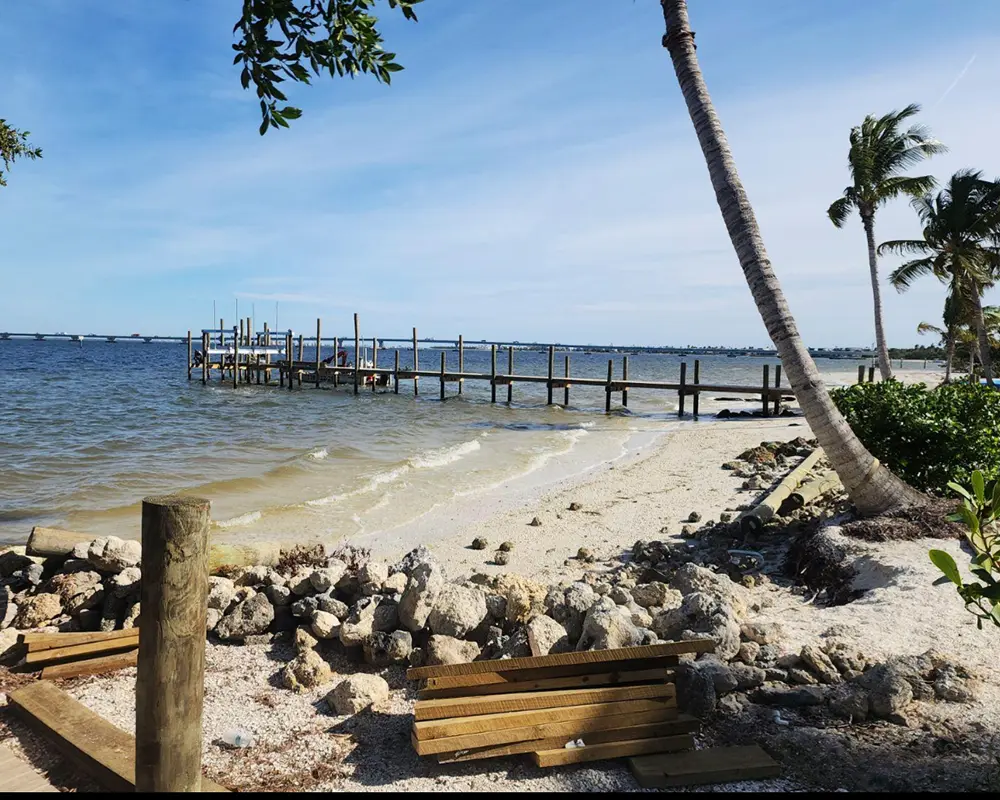
There is no single best dock design.
The perfect dock for someone who takes a center console offshore every weekend may be completely different from the ideal setup for someone who primarily kayaks, fishes from the backyard, entertains friends, or wants a quiet place to watch the sunset.
Your property also gets a vote.
Water depth, tides, currents, wave exposure, shoreline configuration, boat size, available waterfront, permitting requirements, and the bottom beneath the water can all determine which dock designs make sense.
That is why choosing a dock should start with one question:
How do you actually want to use your waterfront?
TL;DR: Which Type of Dock Should You Build?
Most residential docks begin with one of two structural systems: fixed or floating. From there, the dock can be configured as a straight dock, L-shaped dock, T-dock, finger pier, platform dock, or a combination of several designs.
Fixed docks offer excellent stability and work particularly well for permanent waterfront installations and boat lifts. Floating docks rise and fall with the water, making boarding easier where water levels fluctuate significantly. L-shaped and T-shaped docks create more usable waterfront space, while finger piers work well when access to multiple vessels is important. Large platform docks are best for homeowners who want their dock to function as an outdoor living space in addition to a place for their boat.
The right answer depends on your boat, your property, and your lifestyle.
First, Understand Fixed vs. Floating Docks
Before deciding on the shape of your dock, you need to determine how the structure will interact with the water.
Fixed Docks
A fixed dock is supported by pilings driven into the bottom of the waterway. The decking remains at a consistent elevation while the water rises and falls beneath it.
This is the traditional dock system most waterfront homeowners are familiar with.
Fixed docks provide a solid, stable surface and naturally accommodate features such as boat lifts, utilities, fish cleaning stations, seating areas, and larger platforms.
Best for: Permanent waterfront homes, frequent boaters, larger boats, boat lifts, fishing setups, outdoor living areas, and homeowners who prioritize stability.
Pros: Extremely stable underfoot, excellent for permanent installations, compatible with most boat lift systems, easily customized, and capable of supporting larger dock configurations.
Cons: The distance between the deck and the water changes with the tide, installation requires pilings, and certain sites may make piling installation more difficult or expensive.
For many Florida waterfront homes, a properly designed fixed dock is the starting point because of its stability and versatility.
Floating Docks
Instead of remaining at a fixed elevation, a floating dock sits on buoyant components and moves vertically with the water.
The major advantage is consistency.
When the water rises, the dock rises. When the water drops, the dock drops. This keeps the surface of the dock at approximately the same height relative to your boat or kayak.
Floating does not necessarily mean unanchored. Floating docks still require an anchoring system, which can include guide pilings, cables, deadweight anchors, or other systems depending on the site.
Best for: Kayaks, paddleboards, personal watercraft, locations with substantial water-level changes, and situations where consistently low access to the water is important.
Pros: Moves with changing water levels, easier boarding for small watercraft, can be modular, and may work where a traditional fixed structure is less practical.
Cons: Moves with waves and wakes, feels less stable underfoot, contains additional moving or flotation components, and may not be ideal for heavily exposed waterfronts.
A floating dock can also be incorporated into a larger fixed dock rather than choosing one system exclusively.
For example, a homeowner could have a substantial fixed dock for the boat, fishing, and entertaining with a smaller floating platform specifically for launching kayaks and paddleboards.
Straight Docks: Simple and Functional
Sometimes the simplest solution is the best one.
A straight dock extends outward from the shoreline and provides direct access to the water. Depending on the property, it can lead to a boat lift, tie-up area, or small platform at the end.
The design uses space efficiently and avoids adding dock area that the homeowner may never actually use.
Best for: Smaller waterfront lots, straightforward boat access, narrow waterways, homeowners with one primary vessel, and properties where the goal is simply getting from land to navigable water.
Pros: Simple layout, efficient use of materials, smaller footprint, straightforward access to the water, and easy to combine with a boat lift.
Cons: Limited space for entertaining, fishing, storage, or multiple vessels compared with larger configurations.
If your dock is primarily transportation between your backyard and your boat, there may be no reason to overcomplicate it.
L-Shaped Docks: More Room Without a Huge Platform
An L-shaped dock extends away from shore and then turns at the end.
That additional section creates more usable dock frontage without requiring a massive platform.
For boaters, the long side of the L can provide additional access along the vessel. For fishermen, the extra frontage creates more positions to fish from. For families, it provides additional room for chairs, coolers, and people without everyone standing in the same narrow walkway.
Best for: Boaters, fishermen, wider waterfront properties, families, multiple watercraft, and homeowners who want additional usable space.
Pros: More mooring frontage, increased fishing area, good access around boats, flexible layout, and more usable space than a basic straight dock.
Cons: Requires more waterfront area, uses more material, and may not be practical where dock dimensions or waterway encroachment are restricted.
For homeowners who want their dock to serve several purposes, the L-shaped configuration is one of the most versatile options.
T-Docks: Built for Waterfront Access
A T-dock consists of a walkway extending from shore with a perpendicular platform at the end.
Think of it as creating a waterfront destination at the end of your walkway.
The cross section gives you significantly more usable frontage than a narrow straight dock. You can potentially fish from multiple sides, tie up watercraft, add seating, and create a much more functional area at the end of the dock.
Best for: Fishing, entertaining, properties with open water, multiple tie-up points, and homeowners who want to maximize usable space at the end of the dock.
Pros: Excellent access to the water, multiple usable sides, lots of fishing room, good tie-up flexibility, and space for seating or accessories.
Cons: Larger footprint, higher construction cost than a simple straight dock, and not suitable for every waterway or permitting situation.
T-docks are particularly attractive when the waterway opens up beyond the shoreline and there is room to take advantage of the wider platform.
Finger Piers: The Boater’s Dock
If boats are the priority, finger piers deserve serious consideration.
A finger pier is a narrow section of dock extending alongside a boat slip. This gives you access along the side of the vessel instead of only reaching the boat from one end.
That can make loading passengers, carrying fishing equipment, cleaning the boat, handling lines, and accessing different parts of the vessel much easier.
Multiple finger piers can also create dedicated slips for several boats or personal watercraft.
Best for: Serious boaters, multiple vessels, larger boats, families with boats and jet skis, and homeowners who want convenient vessel access.
Pros: Excellent access along the vessel, makes loading and unloading easier, can accommodate multiple slips, and creates an organized marina-style setup.
Cons: Requires more space, adds structure and cost, and may be unnecessary for homeowners with a single small boat.
For a homeowner whose waterfront lifestyle revolves around boating, the convenience can easily justify the additional dock area.
Platform Docks: Turn the Dock into an Outdoor Living Space
Not everyone builds a dock just to reach a boat.
Some homeowners want another backyard.
A platform dock creates a larger open area over the water that can accommodate seating, tables, shade structures where permitted, fishing equipment, storage, and other amenities.
Instead of walking down to the dock, getting into the boat, and leaving, the dock itself becomes part of the destination.
Best for: Entertaining, fishing, waterfront dining, sunset watching, families, and homeowners who spend significant time outside even when they aren’t boating.
Pros: Maximum usable recreational space, excellent for entertaining, plenty of room for fishing, flexible furniture arrangements, and space for additional dock accessories.
Cons: More expensive, requires more materials, creates a larger footprint, and permitting or environmental restrictions may limit how large the platform can be.
If you regularly have friends or family over, the extra square footage can completely change how you use your waterfront.
Captain’s Walk or Long Access Dock: When the Good Water Isn’t at Your Seawall
Sometimes the dock design is determined by depth rather than lifestyle.
A property may have beautiful waterfront but extremely shallow water close to shore. In that situation, the dock may need to extend farther out before reaching enough depth for the homeowner’s boat.
A long, relatively narrow access dock can cross the shallow area and lead to a lift, slip, or larger platform in deeper water.
Best for: Shallow waterfront properties, tidal flats, properties where navigable water sits farther offshore, and homeowners who need to reach sufficient depth for their vessel.
Pros: Provides access to deeper water, can make an otherwise difficult waterfront property functional, and can connect to several different dock layouts at the end.
Cons: Longer construction, more pilings and material, greater exposure to wind and waves, and potentially more complicated permitting.
In these situations, water depth and environmental regulations may determine the design before aesthetics even enter the conversation.
Low-Level Platforms for Kayaks, Paddleboards, and Swimming
A traditional dock can sit relatively high above the water, which isn’t always convenient when you’re trying to climb onto a paddleboard.
A lower fixed platform or floating launch can solve that problem.
These smaller platforms can be incorporated into a larger dock system and positioned closer to water level, making it easier to launch kayaks, paddleboards, and other small watercraft.
Best for: Kayakers, paddleboarders, swimmers, families with children, and homeowners with personal watercraft.
Pros: Easy access to the water, can complement an existing dock, useful for multiple recreational activities, and keeps small-watercraft traffic separate from the primary boat area.
Cons: Lower surfaces are more exposed to waves, wakes, tides, and marine growth, and the design must account for changing water conditions.
For an active family, this can be one of the most-used parts of the entire dock.
Boat Lift Docks: Designed Around the Boat
For many Florida boat owners, the boat lift isn’t an accessory added after the dock is designed.
It should be part of the design from the beginning.
A dock built around a lift can provide convenient access to the helm, bow, stern, storage compartments, and other areas of the boat. Walkways can be positioned where passengers actually board instead of forcing everyone to squeeze through an awkward opening.
The lift itself keeps the vessel out of the water when it isn’t being used, reducing prolonged exposure of the hull and running gear to marine growth and water.
Best for: Frequent boaters, center consoles, bay boats, fishing boats, pontoon boats, and homeowners who keep their vessel at home.
Pros: Convenient boat storage, easier boarding when properly designed, keeps the vessel out of the water, and can be customized around the specific boat.
Cons: Higher overall project cost, requires electrical and mechanical equipment, and the lift needs to be properly sized for the vessel.
If you’re building a new dock and already know which boat will live there, tell your marine contractor the boat’s dimensions and loaded weight before the dock design is finalized. And for more information on different types of boat lifts, read our dedicated post here.
Fishing Docks: Design Around How You Fish
A fishing dock has different priorities than a dock designed solely for boat storage.
You want open edges, room to cast, adequate water depth, convenient rod storage, lighting, and somewhere to clean your catch.
A T-dock, L-shaped dock, or large platform can work particularly well because each provides more fishable perimeter.
You may also want to incorporate a fish cleaning station with water and power, rod holders, dock lighting, underwater lighting where appropriate, and enough open space to land a fish without wrapping the line around furniture.
Best for: Inshore fishermen, families who fish from home, waterfront properties near productive canals or bays, and anyone who wants to use the dock even when the boat stays home.
Pros: Makes the dock useful every day, can incorporate dedicated fishing features, provides more access to the water, and combines well with recreational spaces.
Cons: Larger layouts and accessories increase cost, and poor placement of furniture or pilings can interfere with casting.
A good fishing dock shouldn’t make you work around the dock. The layout should make fishing easier.
Entertainment Docks: Build a Destination
For some homeowners, boating is only half the reason to own waterfront property.
The other half is enjoying the view.
A wider platform or large L-shaped or T-shaped dock can create enough space for seating, tables, coolers, lighting, and gathering areas while still providing boat access.
The key is separating circulation from recreation.
You don’t want guests sitting in the exact area where someone needs to carry fishing equipment onto the boat. A well-designed entertainment dock creates distinct areas for walking, boarding, sitting, and accessing the water.
Best for: Entertaining, sunset watching, waterfront homes with great views, large families, and homeowners who spend significant time outside.
Pros: Expands your usable outdoor living area, takes advantage of waterfront views, accommodates groups, and can still incorporate boating and fishing features.
Cons: Larger footprint and higher construction cost, more accessories and utilities may be required, and permitting can limit size.
If you think you’ll spend more time sitting on your dock than standing on your boat, design accordingly.
What If You Want Everything?
Then don’t choose just one dock type.
Some of the best residential docks are hybrids.
You could build a fixed L-shaped dock with a boat lift on one side, a fish cleaning station near the boat, an entertainment platform at the end, and a small floating kayak launch connected at a lower elevation.
Another homeowner might need a long access walkway through shallow water leading to a T-shaped fishing and entertainment platform with a boat lift positioned alongside it.
The terminology matters less than creating a layout that works.
Your dock doesn’t have to fit neatly into one category.
Match the Dock to Your Lifestyle
Before deciding on a dock design, think about an average Saturday at your waterfront home.
Are you loading fishing rods onto the boat at 6:00 in the morning?
Launching paddleboards with the kids?
Having ten people over for dinner?
Fishing from the dock after sunset?
Keeping multiple boats and jet skis at the property?
Sitting outside with a drink and watching the water?
Your answers should influence the design.
A serious fisherman may value open casting space and a cleaning station more than a huge seating area. A family with kayaks and paddleboards may get more use from a low floating platform. Someone with a large center console may care primarily about a properly positioned boat lift and easy access around the vessel.
Build for what you actually do, not simply what looks impressive in a photograph.
Your Waterfront Conditions Still Come First
Lifestyle determines what you want.
The property determines what is possible.
Before a final dock design is selected, factors such as water depth, tidal fluctuation, current, wave and wake exposure, shoreline conditions, bottom conditions, vessel draft, waterfront dimensions, neighboring structures, and applicable permitting requirements all need to be considered.
A floating dock, for example, can be excellent where changing water levels make access difficult because it moves with the water. A fixed dock provides a much more stable permanent platform and works naturally with many boat lift installations. Long access docks can solve shallow-water problems, while larger L and T configurations require sufficient space to extend along or into the waterway.
There isn’t a universal answer because there isn’t a universal waterfront property.
Design the Dock Around the Way You Live
A dock is one of the most important features of a waterfront property.
Done correctly, it isn’t simply somewhere to park the boat. It’s where fishing trips begin, where kids launch paddleboards, where friends gather, where you clean the day’s catch, and where you sit at the end of the day when you don’t feel like going anywhere at all.
That’s why Overall Outdoor & Marine Services designs docks around both the property and the people who will actually use them.
Whether you need a straightforward fixed dock, floating dock, boat lift setup, fishing platform, T-dock, L-shaped dock, kayak launch, or a custom combination of several designs, our marine team can help determine what works for your waterfront.
Contact Overall Outdoor & Marine Services today to start planning your new dock, dock replacement, or waterfront renovation.